
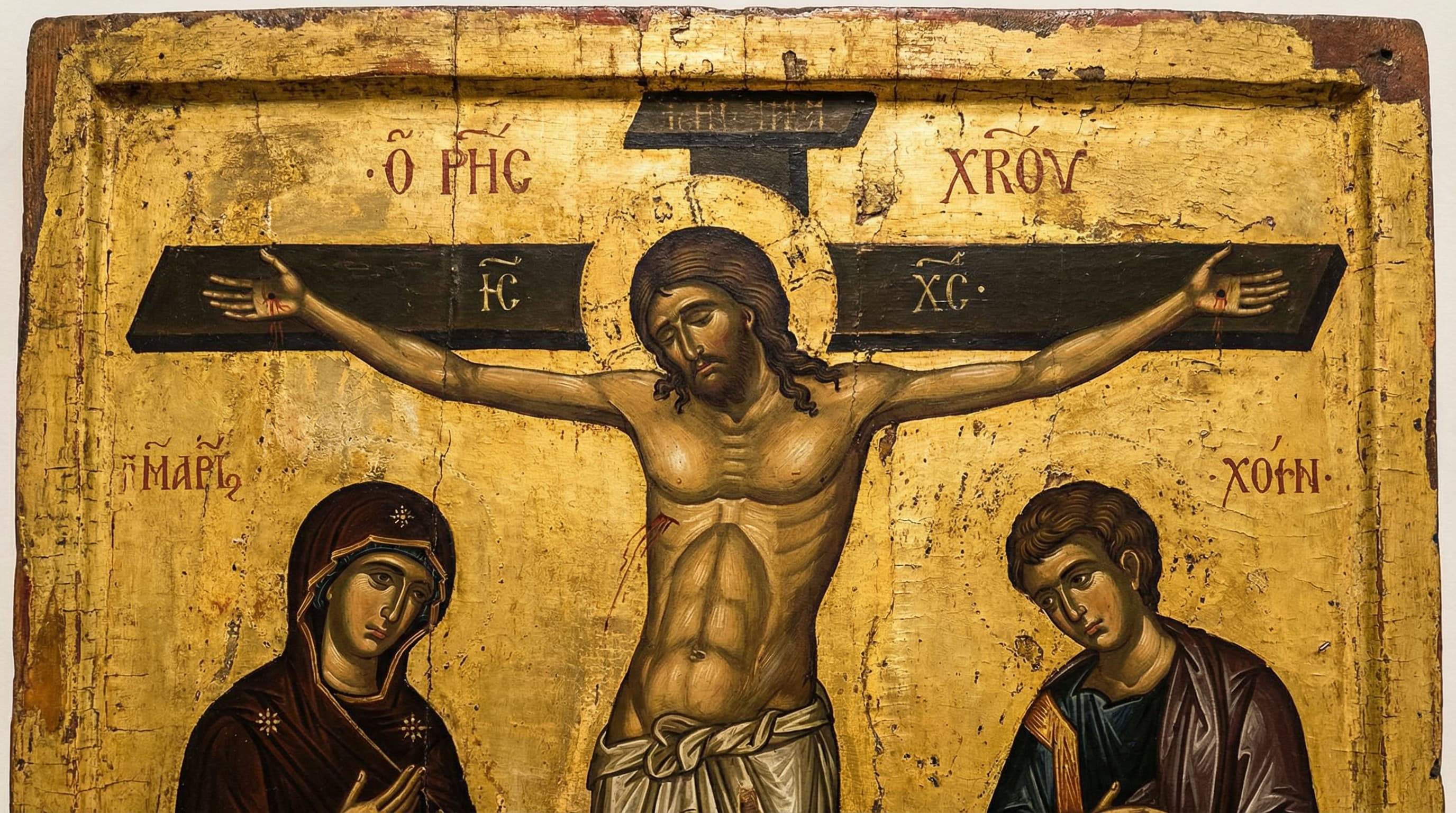
Easter, The Greatest Story Ever Told
No religious founder in history has ever done this: setting, the night before his own death, the framework of meaning for that death, and asking his friends to renew this gesture in his memory forever. What does all of this actually mean? Let's understand the gift of Easter.
The story of Easter is a letter to us written in blood, nails, and a cross raised on a hill one Friday, two thousand years ago. To truly understand what it means, we need to go back a little. Very far back, in fact. All the way to the origins of humanity.
Something Within Us Knows There Is a Debt
Since the beginning of time, everywhere on earth, human beings have made sacrifices.
Peoples who did not know each other, who did not speak the same language, who had never heard of one another — in Mesopotamia, in Greece, in Mexico, in India, in Israel — all independently developed the same gesture: offering something precious to an invisible power, to restore a broken balance.
Why? Because there is within us a very ancient, very deep feeling that could be called the sense of debt. A peasant who survives a terrible drought while his neighbours die of hunger feels something strange: why me and not them? He cannot keep that to himself. He brings his finest ox to the altar of the gods. A warrior who returns alive from a battle where death cut down those around him offers also a sacrifice. A father whose child has just escaped illness gives his own blood as an offering. And even today — a man who narrowly escapes death in a car accident and walks home unharmed feels the instinctive need to give thanks, to give something back, as if receiving without giving in return were morally unbearable.
This universal intuition says something true about the human condition: we do not own our lives. We receive them. And we sense, confusedly, that we are indebted for them.
But there is more than gratitude. There is also the matter of fault.
Human beings have always known, deep down, that they were not what they should be. That there was a gap between the ideal and the reality. Between the person they wished to be and the person they actually were. This gap creates a kind of existential unease — a debt owed to something greater than oneself. And to bridge this debt, to repair what is broken, human beings sacrificed.
The central idea of sacrifice, in almost every tradition, is substitution: I am the one who should pay. But I will have this animal die in my place. It will carry what I cannot bear. This is a logic we all understand intuitively. When we have deeply hurt someone we love, we feel the need to do something. To pay a price. Not because the other person is cruel and demands reparation — but because love itself calls for an act, a proof, a gesture that costs something. But Animals Are Not Enough
The problem is that human beings eventually felt, themselves, that it wasn't truly sufficient.
Can an animal, however fine, really carry the weight of a human life? Can it repair a betrayal, a cowardice, years of lying, violence done to a child? The prophets of Israel said it themselves, with brutal frankness: "Your sacrifices weary me. What I want is not the blood of bulls — it is a transformed heart."
The sacrificial system was like a bandage placed over a deep wound. It brought relief, it allowed life to go on, it maintained a connection with God. But it did not truly heal. It had to begin again each year, with each fault, with each season. And somewhere, in the depths of Israel's heart, there was an expectation — almost a nostalgia in advance — for a sacrifice that would finally be equal to what it was meant to repair.
So God Decides to Act Himself
And this is where the story becomes extraordinary. The Christian answer says this, and we must take time to measure its weight: God does not watch the situation from a distance, waiting for sufficient reparation. He decides to enter the logic of sacrifice himself — on the side of the victim.
In Jesus, God becomes human. He takes on a body, a childhood, a family, fatigue, hunger, friends, tears. He lives among the poor, the sick, the outcasts. And after three years of a public life that transformed everything it touched, he walks deliberately toward Jerusalem for Passover. He knows what awaits him. His disciples try to dissuade him. He gently sets them straight, and he walks on.
What happens next, on the night of Holy Thursday, is perhaps the most astonishing act in the entire religious history of humanity.
Jesus gathers his disciples for the Passover meal. This is the traditional dinner commemorating the liberation of the Hebrews from Egypt — a meal laden with meaning for centuries. And there, around that table, Jesus does something no one had ever done before and no one will ever do again: he takes the bread, breaks it, and says — knowing that he will be crucified the following morning — : "This is my body, given for you." Then he takes the cup of wine and says: "This is my blood, the blood of the new covenant, poured out for the forgiveness of sins."
He institutes himself the rite of his own sacrifice. In full lucidity. With absolute freedom.
No religious founder in history has ever done this: setting, the night before his own death, the framework of meaning for that death, and asking his friends to renew this gesture in his memory forever.
The Friday That Changed the World
What follows, we know in its broad outlines even when we do not read the Bible.
The arrest in the night. The hasty, rigged trial, where testimonies contradict each other. The screaming crowd. Pilate washing his hands. The flogging — blows that tear the skin down to the bone. The crown of thorns pressed into the skull. The cross carried through the city under jeers and spitting. And finally, the nails.
Nailed to a cross between two bandits, suspended between heaven and earth, in a pain that words cannot describe, Jesus says three things that sum up everything he is:
He says to the first repentant bandit, the one who asks him to remember him: "Today you will be with me in paradise." Until his last breath, he welcomes.
He says of those who are crucifying him: "Father, forgive them, for they do not know what they are doing." Until his last breath, he intercedes.
And when everything is fulfilled, he says simply: "It is finished." This is not a sigh of exhaustion. It is a declaration of victory. The mission is complete. The door is open.
Now, what does all of this actually mean?
Humanity had a profound problem. Not simply behaviours to correct, not simply bad habits to improve. Something structurally broken in its relationship with God — an accumulation of refusals, indifference, pride, violence — which theologians call sin, understood not as a list of faults but as a condition, a fundamental orientation toward oneself rather than toward God and others.
This condition creates a real distance. And a real debt. One that cannot be erased with a wave of a magic wand — because evil has real consequences that do not disappear by decree. Someone must pass through them.
And this is exactly what Jesus does. He takes upon himself all that distance, all that debt, all that darkness — and he passes through it to the very end, to death itself, on the cross.
And then, three days later, he rises.
Death did not have the last word. The darkness did not win. The sacrifice is accomplished — definitively, once and for all — and the resurrection is its blazing proof. The door is open. The distance is bridged. The covenant is sealed, no longer in the blood of lambs that had to be offered again each year, but in the blood of God himself, freely given, once, for eternity.
There is, however, one important thing to understand: this gift does not impose itself.
Jesus saves no one by force. He opens a door — at a price the mind struggles to grasp — but it is our choice to walk through it. And walking through it means something concrete. He says it himself, plainly: "If anyone wishes to come after me, let him deny himself, take up his cross and follow me."
Taking up one's cross. This does not necessarily mean dying as a martyr. It means agreeing to live differently. To give up the small, comfortable logic of me first. To love when it is hard. To forgive when it is painful. To choose truth when lying would be more convenient. To place oneself in service when the dominant position would be more flattering.
It means dying, in a sense, to a certain image of oneself. But Jesus promises something in return: "Whoever loses his life for my sake will find it." What we give up is nothing compared to what we receive.
So this is what Easter celebrates.
Not simply the death of a good man. Not simply a moral lesson about courage or generosity. Something far more breathtaking: God, who owed us nothing, who could have left us to our fate, chose to enter our darkness. To take on a body. To suffer. To be betrayed, humiliated, tortured, nailed to wood.
Why? To give us what we could not give ourselves: reconciliation with him. Eternal life. The possibility of becoming, we imperfect and fragile creatures, beings of light. He did not send an envoy. He did not write a law. He did not set conditions from the heavens.
He came himself. He paid himself. And he said, arms spread wide on that cross which is at once the most infamous instrument in Roman history and the most glorious throne in the history of the world: "I love you. And to prove it, I am ready for anything."
Happy Easter 🥚and Blessings ! Please Follow us @virggilAI
Explore Virggil
AI that answers with your values, not the consensus. Try the first Christian AI companion.
Try Virggil Free